Musa Sabedini releases in-depth book titled “Investigative Journalism: Mission, Risks, Ethics, and Professional Challenges”
 RajoniPress
07:20, 13 Janar, 2026
| 8 muaj më parë
RajoniPress
07:20, 13 Janar, 2026
| 8 muaj më parë
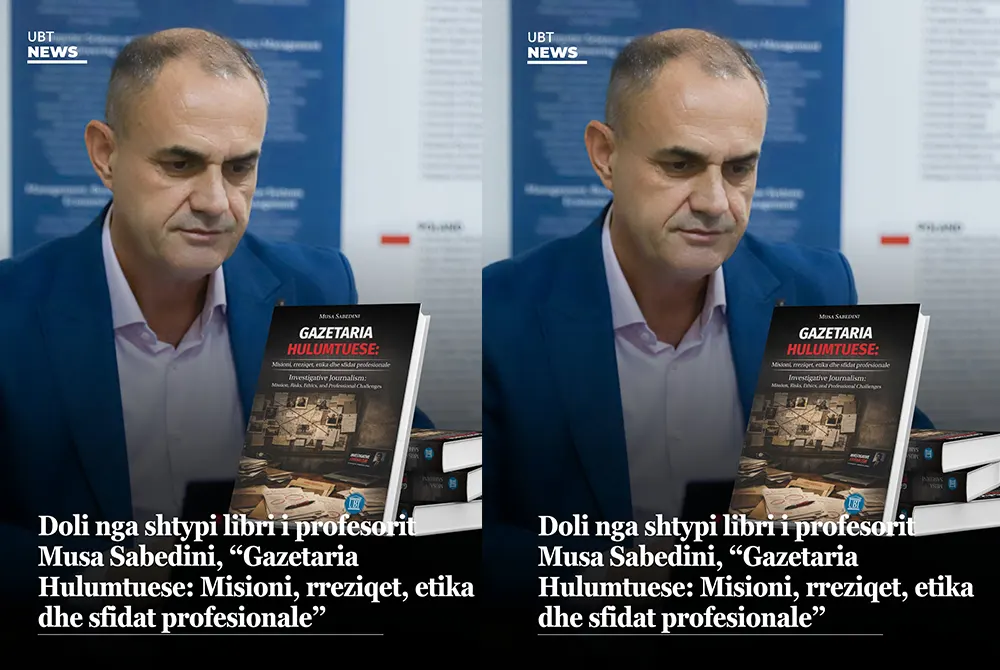

Professor, journalist, publicist, and researcher at the Faculty of Media and Communication, Musa Sabedini, has published his fourth university textbook titled “Investigative Journalism: Mission, Risks, Ethics, and Professional Challenges.” The book is dedicated to journalism students, media researchers, investigative journalists, professional editors, journalists, and honest, committed, and courageous media professionals in all challenging times.
Having been actively involved in investigative journalism for a long period and having researched numerous topics of great importance in post-war Kosovo, the author stated that this book, bearing the professional title “Investigative Journalism: Mission, Risks, Ethics, and Professional Challenges”, represents the culmination and crowning achievement of more than 35 years of experience in professional journalism, with a particular emphasis on investigative reporting.
The professor, journalist, and tireless media researcher emphasized that finalizing this life project was not easy, yet not impossible.
“After decades of fieldwork, after receiving four national awards for investigative journalism, I felt a responsibility for this experience not to remain only a personal memory, but to be transformed into a practical and inspiring guide for new generations of journalists—those who seek to challenge reality, uncover the truth, and defend the public interest, even in complex and often dangerous circumstances. This book is the result of my devotion to the mission of investigative journalism, to a profession that makes no compromise with falsehood. Through this work, I aimed to convey a clear message to students, colleagues, researchers, editors, and media owners that investigative journalism is the foundation of democracy and the voice of public conscience,” Sabedini stated in the book’s foreword.
The professor, author of four university textbooks focusing on media studies highlighted that this book is among the first in the Albanian-speaking sphere to address the role, mission, and dimensions of investigative journalism with academic rigor and practical dedication by merging experience with academic reflection.
“The book is not merely a manual, but a journey through real experiences, challenges, risks, and ethical dilemmas faced by every journalist in the pursuit of truth. My professional experience, the awards received, documented death threats in more than 35 cases related to investigative topics I have covered, and the pressures endured over many years have all served as a solid foundation for this book’s content. It includes concrete analyses, theoretical definitions, methodological guidelines, and practical examples that help students and professionals gain a deeper understanding of the essence of investigative journalism. The book is built upon a decade long rich archive, enriched by my academic experience as a lecturer at UBT College, where for years I have had the privilege of sharing knowledge and experience with journalism students. This journey has been further strengthened through participation in 14 international conferences and through research work that enabled me to integrate practice with scientifiSabedini emphasized.
The book’s reviewer, Safet Zejnullahu, stated that Musa Sabedini’s “Investigative Journalism: Mission, Risks, Ethics, and Professional Challenges” comes at a time when the foundations of journalism are being significantly shaken by the influence of technology.
“Traditional journalism, at the time when the foundations of what we still recognize today as investigative journalism were laid, was entirely different from journalism today. Opportunities were far more limited, but professionalism was at a much higher level. Today’s internet journalism, on the other hand, offers exponentially greater opportunities. However, investigative journalism seems to have been overshadowed and overwhelmed by the abundance of superficially covered topics, driven by the need for speediness, releasing facts day by day instead of thoroughly exhausting them through in-depth investigation and comprehensive publication,” Zejnullahu stated.
He wrote, the author of this voluminous book has justifiably divided the materials into three parts.
“In the first part, the author focuses primarily on the mission, risks, and challenges of investigative journalism, accompanied by concrete examples of the most notable cases of success at both international and domestic levels. The second part addresses the impact of internet journalism on investigative journalism, a field that has introduced many new phenomena to what is considered the pinnacle of successful journalism. In the final part, the author examines modern techniques of investigative reporting in the media of the internet era. A special section of the book consists of 101 questions or guidelines for investigative journalism, derived from relevant literature and concrete cases, addressing the professional, ethical, legal, and logistical dimensions of investigative reporting. With its extensive analysis of concrete examples, legal frameworks, ethical dilemmas, and suggestions on how to practice investigative journalism in the internet age, this book is an undeniable resource for media researchers anZejnullahu assessed.
According to him, the book will serve journalism students as a valuable source for learning the fundamentals of investigative journalism, especially in a challenging time for journalism overall, influenced by rapid technological advancements.
“This book, like all research related to investigative journalism, will serve all professionals as a call to engage in investigative journalism at the highest professional level; to treat it as the crown of all journalistic content. Its past convinces us that only those who have practiced genuine investigative journalism are remembered; the rest are merely news writers. Ultimately, it must be made clear that there can be no media or professional journalism without investigative articles, without investigative journalism. It has been, is, and will remain the pillar of journalism in every time and form,” Zejnullahu wrote.
The book’s foreword also outlines its structure, which consists of three main chapters, each with distinct thematic focus and depth.

The first chapter addresses definitions, mission, risks, and challenges of investigative journalism. It includes reflections on ethics, morality, neutrality, and the independence of the investigative journalist, as well as analyses of well-known international and domestic scandals, drawing lessons for the professional and human approach required by this profession.
The second chapter focuses on the digital era and its impact on investigative journalism. It discusses the transformation of the profession in the age of technology, new boundaries of reporting, the role of insiders, ethical challenges, and the risks posed by the lack of legal protection for journalists.
The third chapter examines modern techniques of investigative reporting in online media, the role of multimedia, artificial intelligence, and social media in shaping contemporary journalism. It also analyzes the legal and ethical aspects of using hidden cameras and digital reporting, offering a comprehensive overview of the evolution of investigative journalism in modern times.
Professor Sabedini emphasized in the foreword that the most distinctive and important feature of the book remains the 101 questions and 101 guidelines, carefully crafted with dedication, recognizing how difficult an initial investigation can be for a young journalist and how valuable these guidelines are for experienced journalists, responsible editors, and university professors.
“These questions reflect not only the professional dilemmas of an investigative journalist but also the ethical, legal, psychological, and logistical dimensions of the investigative process. They are intended to serve as an ‘ethical and practical guide’ for every investigative journalist, especially journalism students at all levels of study. These questions and recommendations are personal, original, and foundational. They stem from my professional concept and from the long journey filled with challenges and sacrifices that I have experienced as an investigative journalist in Kosovo and beyond,” Sabedini said.
He expressed gratitude to UBT Rector Edmond Hajrizi for his trust, support, and dedication to academic and professional development.
According to Sabedini, this book is more than a professional publication; it is a narrative of experience, passion, and dedication to journalism as a life mission.
“The book is the result of deep understanding and spiritual engagement with the digital and online world, which brings risks that are as delicate and challenging as they are fast-paced and beneficial to the contemporary world. It is an invitation to all who believe that the truth deserves to be exposed, regardless of the obstacles and risks it entails,” he concluded.
Musa Sabedini, as an investigative journalist and university professor, is the author of over 14 scientific papers, defended and presented over the years at international conferences organized by UBT. He has published scholar works in American journals and in SCOPUS, and since 2011 has been a lecturer in the Media and Communication Department at UBT, where he teaches four core courses in journalism and media ethics.
Professor Sabedini was a member of the Board of the Kosovo Press Council for 14 years and has led an online news portal for the same period.
For his professional contribution, Professor Musa Sabedini received four awards in the category of investigative journalism in Kosovo, in the years 2003, 2006, 2007, and 2008, from various professional juries.
The book published by UBT College comprises 718 pages./rajonipress/ubtnews/.