
From experience to academic guide: Media lecturer and scholar Musa Sabedini launches at UBT his book on investigative journalism
 RajoniPress
17:15, 17 Janar, 2026
| 7 muaj më parë
RajoniPress
17:15, 17 Janar, 2026
| 7 muaj më parë
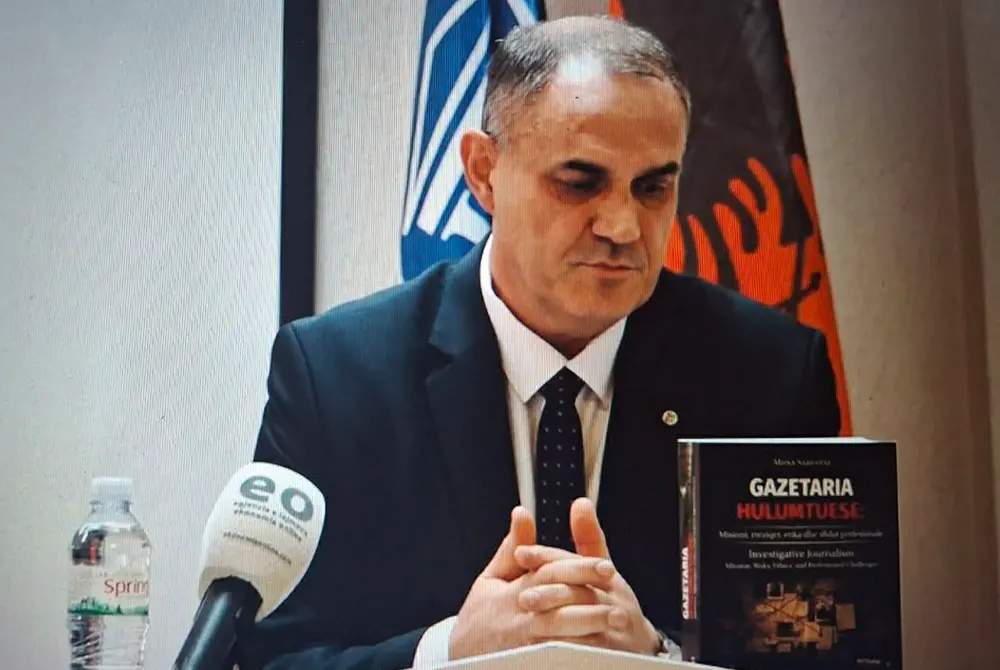

An academic and cultural event of particular significance for the university community and Kosovo’s media landscape was held at the premises of the University for Business and Technology (UBT): official release of the latest book by lecturer, journalist, and publicist Musa Sabedini, which is being widely recognized as a substantial contribution to the theoretical and practical development of investigative journalism in Kosovo and beyond.
The comprehensive volume “Investigative Journalism: Mission, Risks, Ethics, and Professional Challenges” was officially promoted with the presence of the UBT Rector Prof. Dr. Edmond Hajrizi, university lecturers, students, media scholars, as well as the author’s friends and family members. The book is dedicated to journalism students, media researchers, investigative journalists, editors, and committed professionals who, even under difficult circumstances, remain loyal to the truth and the public interest.
The event was characterized by an open academic dialogue between the author and the participants. In addition to presenting the structure and content of the book, the discussion addressed contemporary challenges of investigative journalism, ethical dilemmas, and its essential role in the functioning of democracy.
The book was received with high appreciation by attendees, confirming its importance as a reference source for the study and practice of investigative journalism in Kosovo and the wider region.
In his welcoming address, the UBT Rector Prof. Dr. Edmond Hajrizi congratulated Sabedini on the publication of the book, counting it as one of the most important and highest-quality works in the field of investigative journalism within the Albanian-speaking academic space.
Meanwhile, Ferid Selimi, the Dean of the Faculty of Media and Communication at UBT, praised Professor Sabedini’s professional commitment and continuous contribution to the development of critical and professional thinking among journalism students.
The book’s reviewer, Safet Zejnullahu, emphasized that “Investigative Journalism: Mission, Risks, Ethics, and Professional Challenges” comes at a time when the traditional foundations of journalism are being profoundly shaken by the impact of digital technology.
He noted that, unlike traditional journalism – where professionalism was more consolidated despite technical limitations – today’s online journalism offers numerous opportunities, yet has often weakened the depth and rigor of investigative journalism due to the pressure of speed and the fragmentation of information.
According to Zejnullahu, the author has rightly structured the book into three main parts: the first part addresses the mission, risks, and challenges of investigative journalism, illustrated through concrete domestic and international cases; the second part analyzes the impact of internet journalism and the transformation of the profession; while the third part focuses on modern investigative reporting techniques adapted to the digital era.
A particular value of the book, according to the reviewer, lies in the 101 questions and guidelines for investigative journalism, developed on the basis of professional experience, relevant literature, and concrete cases, encompassing the professional, ethical, legal, and logistical dimensions of investigative journalism.
Speaking about the book, Professor Musa Sabedini emphasized that the work represents the culmination of more than 35 years of professional journalism experience, with a special focus on investigative journalism. He underlined that the book is not only a professional manual, but a profound academic reflection on real experiences, challenges, risks, and ethical dilemmas of the profession.
The author highlighted that the book’s content is grounded in a rich professional archive, his academic experience as a lecturer at UBT, participation in international conferences, and scientific papers published in prestigious journals.
According to him, the 101 questions and guidelines constitute the practical core of the book, serving as an ethical and professional guide for students, young journalists, as well as experienced media professionals. Professor Sabedini stressed that investigative journalism remains one of the most important pillars of modern democracy, an essential mechanism for uncovering scandals, illuminating injustices, and protecting the public interest.
He emphasized that at a time when political and economic pressures on the media are increasing, investigative journalism must be protected and developed as a public good, requiring institutional support, civic engagement, and strong professional integrity.
The book concludes with a clear message to younger generations of journalists: professionalism, courage, integrity, and commitment to the truth are the fundamental for the survival and dignity of investigative journalism.
Former Deputy Prime Minister Mr. Hajredin Kuqi, as well as esteemed colleagues Mr. Faton Ismajli and Mr. Betim Musliu contributed the promotion with their discourses./UBT News/